IVF or IUI?

We see that a considerable number of couples who come to our center hoping to have a child have this question on their minds. To be honest, it is a topic that is still debated among us physicians and gynecologists as well. After the couple's medical evaluation, in order to determine the most suitable treatment for them, the decision should be made together, explaining success rates and processes and making the necessary comparisons where needed. In other words, treatment should be individualized.
In infertility treatment, that is, treatment to help a couple conceive, no single approach gives the same result in all patients with the same characteristics.
We often see that patients who come to us wanting a child ask to be treated with ovulation pills, or that this has already been recommended to them. An important distinction needs to be made here. If a woman has been diagnosed with an ovulation problem, ovulation can first be achieved in an economical way. With these simple treatments, ovulation occurs in more than half of patients, but unfortunately pregnancy rates are not equally high. Since the response to these treatments may decrease after 5-6 months, if pregnancy is not achieved, they should not be insisted on after a few attempts.
In patients who have regular periods, whose tests and examinations already show a normal number of eggs and normal egg development, and who are thought to be ovulating, these treatments offer no additional benefit. In other words, it is not right to start every patient on the most economical and simplest treatment first.
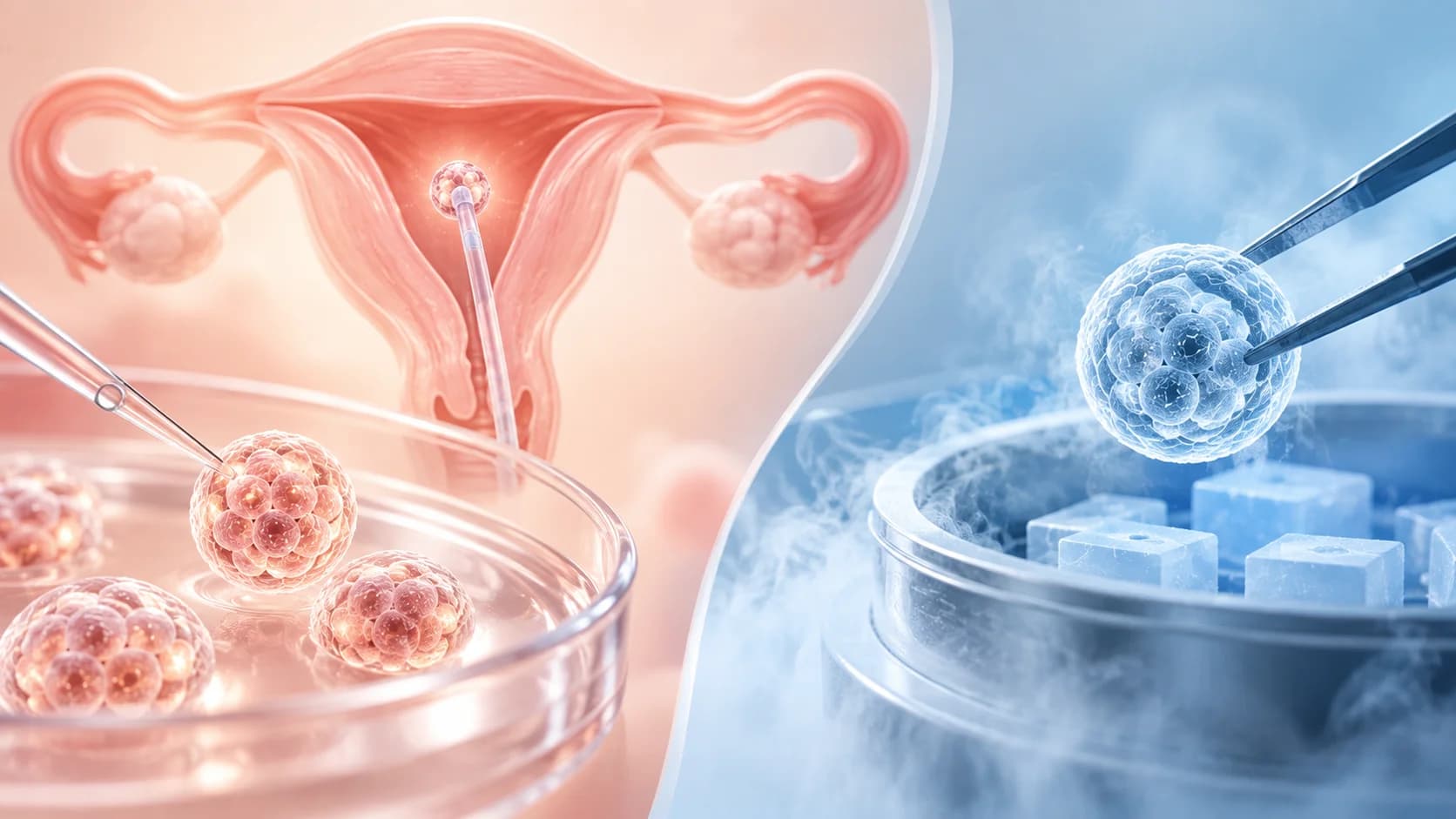
Today, the right approach is to try to shorten the time it takes to achieve pregnancy. This is where assisted reproductive techniques come in, namely IUI (intrauterine insemination) or IVF (in vitro fertilization).
In patients who have no ovulation problem but have been unable to conceive after a certain period of time, the most important factor is the woman's age. In addition, the husband's semen analysis result and whether the fallopian tubes are open are important in determining the treatment to be chosen. In patients whose tubes are not open, or whose partner has a very low sperm count, meaning there are not enough sperm for natural intercourse or insemination, it is clear that IVF is needed.
Does it make sense to recommend IVF instead of IUI to a couple for whom IUI could also be an option?
At first glance, the answer that comes to mind is probably "Why would you?" ... "No." However, as mentioned at the beginning of this article, once a comparison is made and the treatment is individualized, the answer to this question may well be "yes."
If we go back at least 10 years, IUI was generally the preferred method for patients in this situation. That is because the success rate of IUI was calculated as 15-20%, while that of IVF was only slightly higher. At the same time, IVF was a much more expensive option compared with IUI.
Today, conditions have changed completely. The success rate of IUI is still the same, but in parallel with advances in technology and science, the success rate of IVF has increased considerably. Compared with 10-15 years ago, there is no longer a big difference between the cost of IVF and IUI. In other words, IVF is now a far more successful and more accessible option than IUI. As a result, because of these developments, IVF is now being chosen earlier by both patients and physicians, even for patients who could actually have IUI.
Of course, this does not mean that every patient should have IVF. However, it is important to discuss the success rate of IUI before treatment. Particularly in women under 32 whose egg count is not critical, if it has been confirmed that the tubes are open and the sperm parameters are good enough to benefit from IUI, IUI can be recommended after explaining the success rate and the treatment process. If pregnancy does not occur, and in older women, especially when pregnancy has not been achieved for more than 3 years, it is important to have a child before the woman's age advances further and the chance of success decreases. This is especially true if a second child is being considered in the years ahead.
In conclusion, when IVF is recommended to a couple, it should not be perceived as meaning the couple has no option other than IVF. Rather, considering the couple's situation, it should be offered as an option because it increases the chance of pregnancy and shortens the time to a result.
Wishing all our couples to have children when they wish, stay healthy...
Dr. Gerçek AYDIN
Last updated: