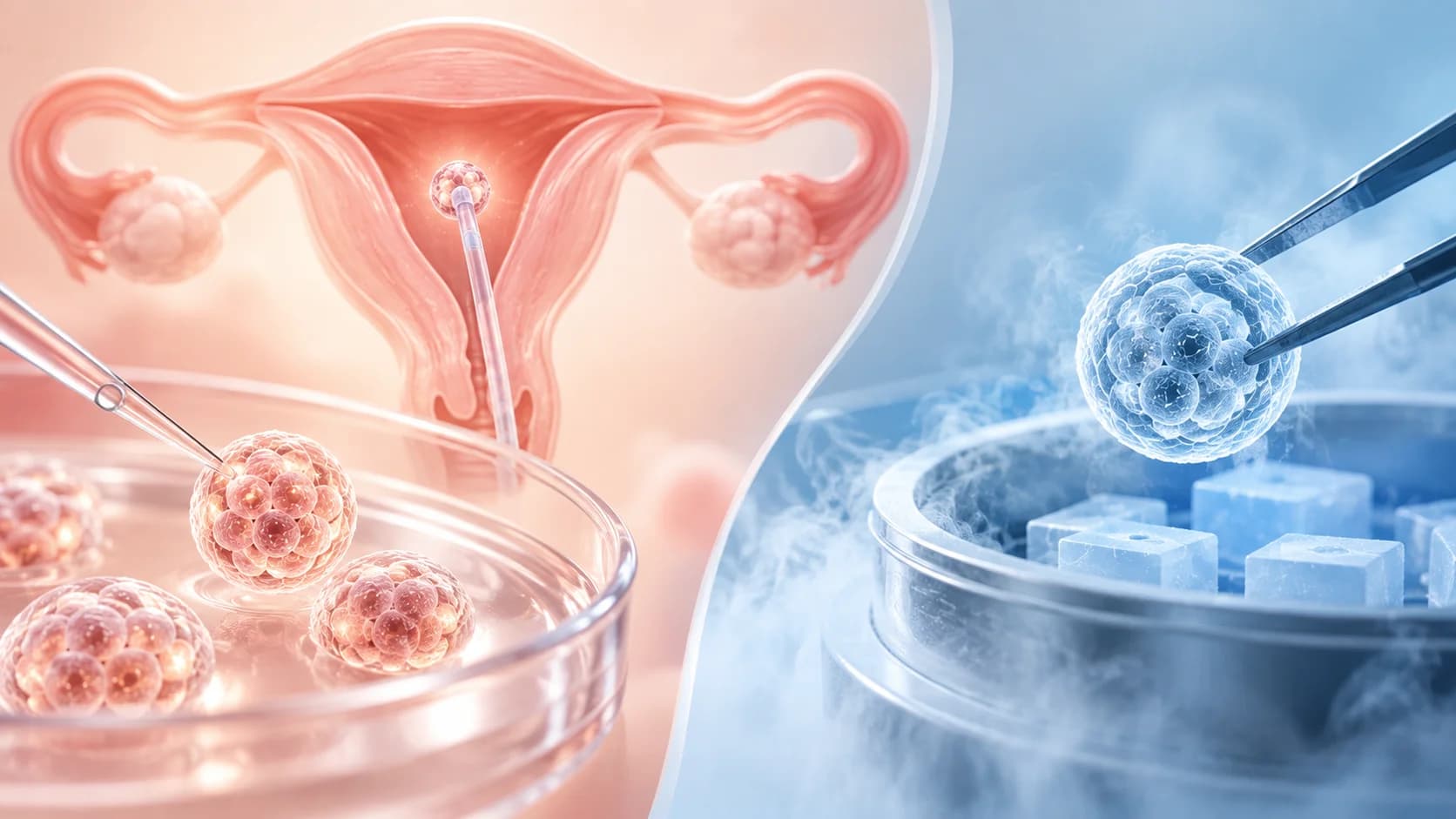
Day 3 or Day 5: Which Embryo Transfer Is More Successful?

One of the most frequently asked questions in IVF treatment is "Is a day 3 or a day 5 embryo transfer more successful?" Especially online and on social media, there is a widespread belief that day 5, or blastocyst, transfer delivers a higher pregnancy rate for every patient. However, when it comes to embryo transfer, waiting until day 5 is not a better or more successful option for every patient.
The success of an embryo transfer is not determined by the transfer day alone. Many factors must be evaluated together, including maternal age, ovarian reserve, the number of embryos obtained, embryo quality, previous IVF treatments and the experience of the embryology laboratory.
Particularly for patients with only a few embryos or a single embryo, keeping the embryo in the laboratory until day 5 simply to see whether it reaches the blastocyst stage may not always be an advantage.
The real goal of IVF treatment is not to obtain a day 5 blastocyst, but to achieve a healthy pregnancy and a live birth. That is why the day of embryo transfer should be decided individually for each patient.
How Does Embryo Development Progress?
After the egg is fertilized by the sperm, the embryo goes through several developmental stages in the laboratory:
- Day 1: Fertilization is assessed.

- Day 2: The embryo usually has 2-4 cells.

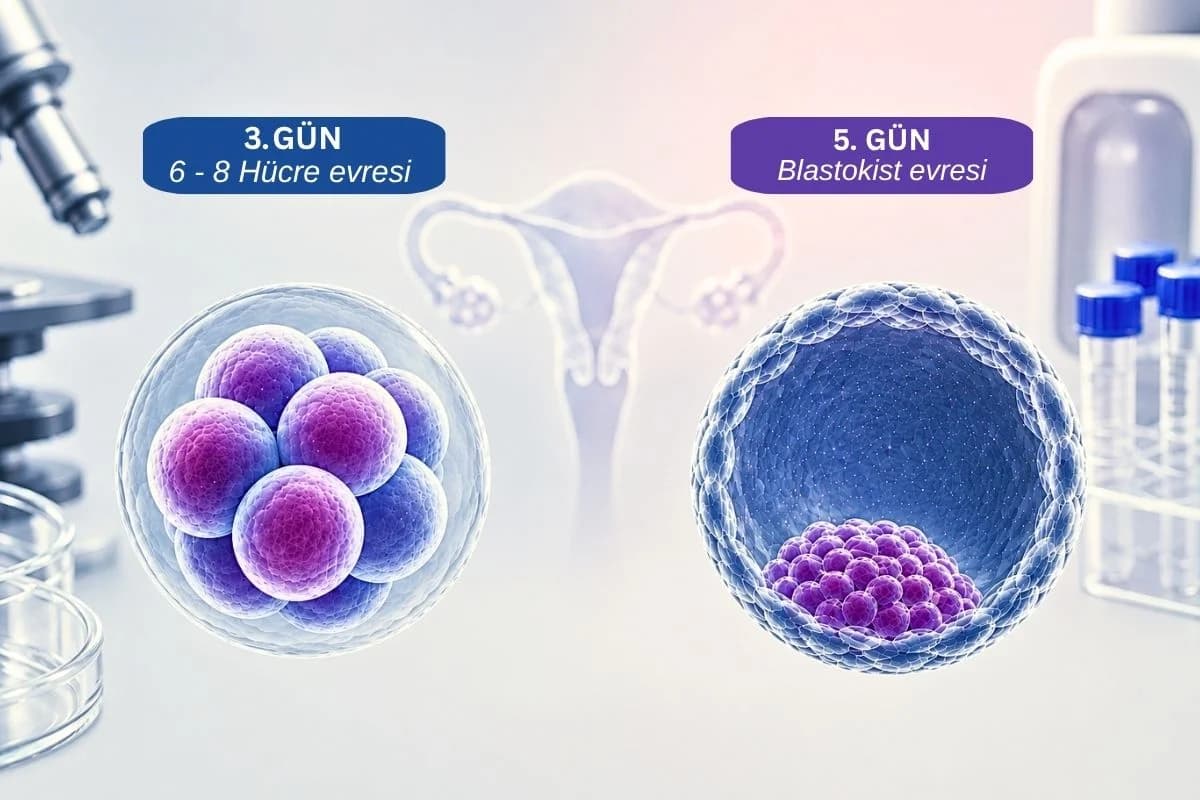
- Day 3: The embryo is usually at the 6-8 cell cleavage (division) stage.

- Day 4: The embryo progresses to the morula stage.

- Day 5: Embryos that develop well may reach the blastocyst stage.

However, not every embryo develops at the same pace. With the wider use of time-lapse imaging systems, it has become possible to observe in much greater detail how the developmental dynamics of embryos can differ from one another.
Some embryos reach the blastocyst stage earlier, while in others blastocyst development may extend to day 6 or even day 7. So when assessing embryo development, it is not only "which day" it is that matters; the rate of development and the morphological features of the embryo must also be taken into account.
What Is Blastocyst Transfer?
The blastocyst is one of the advanced stages of embryo development after fertilization and usually forms on day 5 or 6.
In an embryo at the blastocyst stage, three main structures are assessed:
- Inner cell mass (ICM): The group of cells that will go on to form the fetus.
- Trophectoderm cells: The cells that will contribute to the formation of the placenta.
- Blastocoel cavity: The fluid-filled cavity that forms inside the blastocyst.

Placing the embryo into the uterus after it has reached this stage of development is called blastocyst transfer.
What Are the Advantages of Day 5 Blastocyst Transfer?
For patients with a sufficient number of good-quality embryos, day 5 blastocyst transfer can offer important advantages in IVF treatment. Following the embryos in the laboratory for a few more days makes it possible to evaluate the embryos that continue to develop and to select the one with the highest implantation potential.
The possible advantages of day 5 embryo transfer include:
- Being able to choose among embryos that have successfully continued their development,
- Identifying embryos with high implantation potential,
- Better synchronization between the development of the embryo and the uterus,
- Being able to plan a single embryo transfer with greater confidence,
- More advanced embryo selection in patients with many embryos.
For this reason, blastocyst transfer can be a very successful treatment strategy, especially for patients with more than one good-quality embryo.
However, most of these advantages depend on being able to choose among several embryos. If there is only one embryo in the laboratory, the selection advantage offered by blastocyst culture naturally disappears.
Is Blastocyst Transfer Suitable for Every Patient?
No. Blastocyst transfer is not the right option for every patient.
There is a common belief that "If the embryo reaches day 5, the chance of pregnancy will definitely increase." Yet current scientific evidence shows that this does not hold true for every patient.
The main purpose of blastocyst culture is not to make the embryo better in quality, but to make it possible to choose among embryos that are able to continue their development.
But if there is only one embryo in the laboratory, there is no second embryo to choose from. In that case, the real question is:
Does keeping a single embryo in culture until day 5 really increase the chance of a live birth?
The answer to this question is: not for every patient.
Some embryos may stop developing before they reach day 5. In such a case, there may be no embryo left to transfer, and the treatment may end without an embryo transfer taking place.
That is why, particularly for patients with a single embryo or only a few embryos, day 3 embryo transfer should be considered as an important option.
The main goal of IVF treatment is not to bring every embryo to the blastocyst stage, but to choose the treatment strategy that maximizes the patient's chance of a live birth.
Does Waiting Until Day 5 Make an Embryo Better in Quality?
No. Keeping an embryo in culture in the laboratory for longer does not improve its biological quality. A poor-quality embryo does not turn into a good-quality embryo simply because it has been kept longer.
The most important advantage of extended culture is that it allows a natural selection among embryos. In other words, blastocyst culture helps identify the embryos that are able to continue developing, rather than giving an embryo new pregnancy potential.
For this reason, the benefit of blastocyst culture becomes clear especially in patients with more than one embryo.
In contrast, for patients with a single embryo, this advantage is significantly reduced because there is no alternative embryo to choose from.
In addition, while the embryo remains in the laboratory for a longer period,
- changes in the culture medium,
- accumulation of metabolic waste products,
- changes in temperature and pH,
- oxygen levels and other environmental factors
may affect embryo development.
Although modern embryology laboratories make every effort to control these variables as well as possible, this does not mean that every embryo must be kept in culture until day 5.
Day 3 Transfer May Be More Advantageous for Patients With a Single Embryo
Scientific studies published in recent years show that in patients with a single embryo, day 3 embryo transfer may in some cases result in a higher live birth rate.
In a large-scale study of 11,163 patients who started their first IVF treatment in Australia and New Zealand between 2009 and 2022, day 3 and day 5 transfer strategies were compared only in patients who had a single zygote (fertilized egg).
According to the study results:
- The live birth rate was 12.5% in the group planned for day 3 transfer
- and 10.1% in the group planned for day 5 blastocyst transfer.
Adjusted analyses showed that day 3 transfer increased the likelihood of a live birth by approximately 24%, and this advantage was reported to be more pronounced at advanced maternal age.
Why Does Waiting Until Day 5 Not Always Offer an Advantage?
One of the most striking findings of the study is that a significant proportion of embryos may stop developing after day 3 without reaching the blastocyst stage.
According to the models:
- About 92% of zygotes reach the day 3 embryo stage,
- The blastocyst formation rate was calculated as about 58.9% at age 35
- and 49.9% at age 40.
This shows that, particularly for patients with a single embryo, waiting until day 5 may in some cases result in no transfer being possible at all.
Of course, these results do not mean that blastocyst transfer is an unsuccessful method. For patients with more than one good-quality embryo, blastocyst culture continues to offer important advantages because it makes embryo selection easier.
However, current scientific evidence shows that the approach "day 5 transfer is better for every patient" is not correct.
The Best Approach in IVF Treatment: Personalized Embryo Transfer
No two patients undergoing IVF treatment have exactly the same clinical situation.
When deciding on the day of embryo transfer, the following
- maternal age,
- ovarian reserve,
- the number of eggs retrieved,
- the number of fertilized eggs,
- the number of developing embryos,
- the rate of development and quality of the embryos,
- the results of previous IVF treatments,
- any genetic tests to be performed,
- the experience of the embryology laboratory
should all be evaluated together.
That is why generalizations such as "day 5 transfer is always more successful" or "day 3 transfer is less successful" are not scientifically accurate.
For some patients, day 5 blastocyst transfer may be the best option, while for another patient a day 3 transfer may be more suitable.
Therefore, the transfer day should not be set as a standard but decided as part of a personalized treatment plan.
Conclusion
Blastocyst transfer is not a goal in itself; it is an effective treatment strategy used in suitable patients.
The key factor in IVF success is not making sure the embryo reaches day 5, but correctly choosing the transfer timing that gives the patient the highest chance of a live birth.
That is why there is no single right answer to the question of whether embryo transfer should be done on day 3 or day 5. The best decision should be made individually, by evaluating the number of embryos, embryo development, maternal age and laboratory findings together.
Frequently Asked Questions
Is a day 5 embryo better than a day 3 embryo?
Not always. An embryo that has reached day 5 has shown that it can continue developing, and this is an important selection criterion. However, this does not mean that keeping the embryo in culture until day 5 will increase the chance of a live birth for every patient.
If there is only one embryo, should it be transferred on day 3 or day 5?
For patients with a single embryo, the decision should be made individually. Since there is no other embryo to choose from, the selection advantage of culturing until day 5 may be limited. For this reason, day 3 transfer may be considered for some patients.
Is day 3 embryo transfer an unsuccessful method?
No. Day 3 embryo transfer is still a valid treatment approach for the right group of patients. The transfer day should be decided by evaluating the patient's clinical characteristics and the number of developing embryos.
Who is blastocyst transfer more suitable for?
Blastocyst culture can generally offer an important advantage for patients who have more than one good-quality embryo, so that a choice can be made among them. However, the decision should be made individually for each patient.
Does waiting until day 5 improve the quality of an embryo?
No. Keeping an embryo in culture for longer does not automatically make it better in quality. One of the main advantages of blastocyst culture is that it allows the selection of embryos that are able to continue developing.
What is the most important measure of success in IVF?
The ultimate goal of treatment is not just a positive pregnancy test or a blastocyst. One of the most meaningful measures of success is achieving a healthy live birth.
Last updated: